
Growing concerns about the ethical issues of Artificial Intelligence technology in education have significantly influenced students’ emotional and behavioural responses to its use, generating what this study refers to as “AI ethical anxiety”. Drawing on multidisciplinary theories, this study examines “AI ethical anxiety” among university students through three interconnected constructs: cognitive ethical concerns, ethical anxiety, and behavioural responses to anxiety. Data were collected from 42 university students using a structured five-point Likert scale questionnaire measuring cognitive concerns, ethical anxiety, and behavioural responses to AI use. The findings revealed high levels of cognitive concerns among participants regarding AI’s potential risks, such as dependency, loss of learning skills, fear of penalties, and uncertainty about academic norms. Notably, the data highlight a distinctive pattern in students’ ethical anxiety, characterised by social-evaluative pressures, such as fear of negative evaluation from teachers or fear of being judged as dishonest or lazy, rather than internal feelings of personal guilt. These anxieties, as the findings revealed, translate into noticeable avoidance behaviours such as limiting AI use in high-stakes tasks, modifying AI-generated content, and employing concealment strategies. These results suggest that when students anticipate the ethical risks associated with AI use, they experience ethical anxiety, which influences their behavioural engagement with it. The study highlights the need for clearer, more concrete institutional guidelines and supportive pedagogical practices to reduce students’ ethical anxiety and foster future AI adoption in education.
____________________
Journal of Digital Pedagogy – ISSN 3008 – 2021
2026, Vol. 5, No. 1, pp. 15-24
https://doi.org/10.61071/JDP.2653
HTML | PDF
____________________
1. Introduction
Though artificial intelligence technology (AI) has now become an indispensable part of modern learning environments, its integration into education still continues to generate debate among academic institutions and educators worldwide. While AI tools offer unprecedented opportunities to enhance teaching and learning, ongoing debates surrounding their use have also generated what recent researchers describe as “AI anxiety”, referring to “experiencing unpleasant feelings of tension, apprehension, and worry with physiological arousal when considering a potentially negative outcome due to the existence or operation of AI” (Yang & Sundar, 2025, p. 3). This anxiety affects not only individuals but also institutional policies, such as inadequate training in AI ethics and responsible use (Alshaibani et al., 2025), and may consequently reduce willingness to accept and use these tools.
Existing studies have shown that while many students appreciate AI’s usefulness, accessibility, efficiency, and support for their learning (Firat, 2023; Strzelecki, 2023; Valova et al., 2024; Shoufan, 2023; Ghounane et al., 2024; Xu et al., 2024; Vieriu & Petrea, 2025), teachers often remain far more concerned and reserved, particularly regarding pedagogical and ethical implications related to academic integrity, increased plagiarism, and the risk of undermining authentic learning (Stokel-Walker, 2022; İpek et al., 2023; Baidoo-Anu et al., 2023; Sullivan et al., 2023; Nguyen, 2023; Lamdjad & Bouhella, 2024; Mehdaoui, 2024).
In this sense, AI anxiety is closely linked to ethical dilemmas (Alshaibani et al., 2025). As teachers increasingly portray AI use negatively or equate it with cheating, ethical concerns have become a central factor influencing university students’ experiences, tensions, and decisions about whether its use might violate academic norms or lead to negative judgement from instructors. Consequently, students experience what this study refers to as “AI ethical anxiety”, defined as the unpleasant emotional discomfort and tension associated with the fear that using AI in academic tasks may violate ethical or academic standards.
From a psychological perspective, anxiety does not exist in a vacuum. First, anxiety arises as a result of perceived threats. According to Technology Anxiety Theory, anxiety can occur when individuals anticipate negative outcomes related to the use of technology (Wilson et al., 2023). That is, emotional discomfort and fear stem from the anticipation of negative outcomes related to AI use (Yang & Sundar, 2025). In this sense, AI ethical anxiety can be said to originate from students’ concerns about AI-related risks or threats (e.g., dependency, misinformation, fears of cheating, penalties, loss of skills, etc.), resulting in unpleasant emotional discomfort. Additionally, ethical anxiety can also be said is significantly shaped by social-evaluative pressure. As Schlenker and Leary (1982) argue, social anxiety increases when individuals feel that their self-presentation may be judged unfavourably. In the academic setting, for example, students may worry about being perceived as dishonest or as cheaters when teachers emphasise strict ethical standards or have strong expectations regarding proper AI use.
Second, anxiety often influences individuals’ behavioural decisions. For instance, when individuals experience heightened anxiety concerning technology, they may have a negative affective response that affects their behavioural decisions (Alkhawaja et al., 2021; Yang et al., 2025). This psychological trait aligns with the Threat Avoidance Theory (TTAT), which asserts that individuals’ perceptions of technological threats can significantly influence their behavioural engagement with technology (Liang and Xue, 2009). Such behavioural engagement may be manifested in adopting protective strategies to manage perceived risks, such as avoidance.
Drawing on the Unified Theory of Technology Acceptance and Use (UTAUT2) model, He et al. (2025) found that ethical anxiety associated with AI use stimulated avoidance behaviours among university students due to concerns about ethical risks. Their study concludes that ethical anxiety directly inhibits AI use behaviours. In a similar study examining college students’ psychological barriers to generative AI adoption, Yin (2025) found that fear and apprehension surrounding generative AI contribute to hesitancy in its adoption. According to Protection Motivation Theory (PMT), individuals often adopt protective strategies to avoid or mitigate perceived threats (Rogers, 1975; Floyd et al., 2000). One of the behavioural strategies students employ involves the use of Intelligent Writing Assistants (IWAs), such as Grammarly, or Automated Paraphrasing Tools (APTs), like QuillBot, to modify their texts in order to avoid plagiarism detection (Ghounane et al., 2024).
Based on these arguments, this study proposes that ethical anxiety relates to the patterns observed between perceived AI-related risks and avoidance behaviours. In other words, students’ worry about AI-related ethical risks, especially under academic pressure, creates emotional tension and an unpleasant feeling that relying on AI might violate ethical or academic standards (known as ethical anxiety). Consequently, this anxiety influences their behavioural decisions about whether to adopt or avoid AI tools.
Previous studies have shown that technology anxiety hinders individuals’ perception of the potential benefits and opportunities presented by technology, suggesting that innovative technology may be seen as a threat rather than a challenge (Alkhawaja et al., 2021; Wilson et al., 2023). With this in mind, ethical anxiety can be considered a psychological barrier to AI adoption in education.
Therefore, it is essential for academic research to examine AI ethical anxiety among students, particularly as AI has become embedded in the DNA of students’ daily practices and learning environments. To date, the impact of AI on students’ affective domain and its influence on their behavioural decisions regarding AI use remain insufficiently explored. Additionally, a review of the existing literature reveals a shortage of comprehensive studies that specifically address the formation of students’ ethical anxiety in response to perceived AI-related ethical risks and its role in shaping their decisions to use or avoid AI tools.
By examining AI ethical anxiety, this study contributes to the existing literature by exploring AI ethical anxiety as an emerging affective and ethical dimension influencing university students’ relation with AI technologies. A second contribution lies in demonstrating that understanding the impact of AI ethical anxiety on students’ behavioural decisions provides valuable insights into the psychological and ethical factors shaping their engagement with AI tools.
2. Research Methodology
The Conceptual Model and Development of Hypotheses
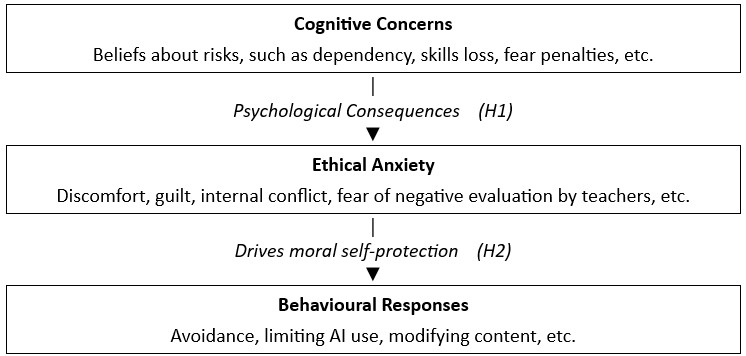
This study assumes that ethical anxiety relates to the patterns observed between perceived AI-related risks and behavioural responses. Accordingly, the study adopts a three-dimensional conceptual model, based on the interrelationship between cognitive concerns about AI-related risks, ethical anxiety, and behavioural responses (see Figure 1).
The first dimension is “Cognitive Concerns”, which includes students’ beliefs about the risks of AI use, such as cheating, penalties, dependence, and loss of skills.
The second dimension is “Ethical Anxiety”, which encompasses students’ emotional discomfort and tension, such as guilt, fear of negative evaluation, or fear of being judged as dishonest or lazy, as explained in Social Anxiety Theory (Schlenker & Leary, 1982; Leary, 1983).
The third dimension is “Behavioural Responses”, which covers students’ behavioural responses and self-protective strategies to avoid or mitigate perceived threats, such as avoidance, concealment, or limiting their reliance on AI, as explained in Protection Motivation Theory (PMT) (Rogers, 1975; Floyd et al., 2000) and Technology Threat Avoidance Theory (TTAT) (Liang & Xue, 2009). To address this, the study posits the following hypotheses:
H1: Students with higher cognitive concerns about AI (beliefs about its risks) are likely to exhibit patterns corresponding with higher levels of ethical anxiety (discomfort, guilt, fear, etc.)
H2: Students who exhibit higher patterns of ethical anxiety regarding AI (guilt, fear, or discomfort) are more likely to display stronger avoidance behaviours (limiting their reliance on AI, hiding its use, etc.).
Figure 1 below summarizes our hypotheses in relation to the research model. The model structure shows how the three key variables build the focus of our analysis
Figure 1
Proposed conceptual research model
Participants and Data Collection
The study participants consisted of forty-two (n = 42) volunteer EFL master’s students enrolled at Ibn Khaldoun University in Tiaret. Data were collected through a survey during the 2025 academic year using a paper-based questionnaire. The researcher visited classrooms during break periods, briefly explained the purpose of the study, and distributed the questionnaires. Prior to distribution, the researcher ensured that all participants had previous experience using AI tools for educational purposes. After the second break period, the researcher returned to the classrooms to collect the completed questionnaires.
Data were gathered using a 21-item self-report questionnaire. It consisted of three sections (7 items for each), aligned with the three-dimension conceptual model and was rated on a 5-point Likert scale (Strongly Agree, Agree, Neutral, Disagree and Strongly Disagree). The items were adapted from established measures in multidisciplinary research: items for Cognitive Concerns were derived from Technology Anxiety scales, items for Ethical Anxiety from Social Anxiety instruments, and items for Behavioural Responses from Threat Avoidance frameworks. To ensure measurement quality and internal consistency, Cronbach’s alpha (α) was calculated for each construct, yielding acceptable reliability estimates for an exploratory study: Cognitive Concerns ( α = 0.79), Ethical Anxiety ( α = 0.81), and Behavioural Responses (α = 0.76).
Data Analysis Method
Given the relatively small sample size (N = 42), the analysis primarily relied on descriptive statistics (percentages and means) to analyse the data. This approach was considered appropriate for addressing the research purpose and aims and for illustrating patterns in the relationships between cognitive concerns, ethical anxiety, and subsequent behavioural responses.
3. Results
The data below represent the results rated on a five-point Likert scale, with Strongly Agree (SA), Agree (A), Neutral (N), Disagree (D), and Strongly Disagree (SD). The data shows students’ responses to statements related to cognitive concerns, ethical anxiety, and behavioural responses to AI use. Responses are presented descriptively using percentage and mean scores.
Section A: Cognitive and Practical Concerns
As shown in Table 1, students reported high levels of concern regarding the cognitive and practical aspects of AI use. Most items recorded mean scores above 3.00, with particularly strong agreement for items related to AI dependency (Item 1, M = 4.07), negative effects on learning (Item 3, M = 4.26), and weakened critical thinking (Item 4, M = 4.12). This suggests that students are highly aware of the long-term risks associated with the overuse of AI and its impact on their personal learning. Participants also expressed significant concerns about their uncertainty regarding acceptable AI use (Item 6, M = 3.64) and its potential violation of academic norms (Item 7, M = 3.69), indicating students’ worry about the lack of clear academic guidance on AI use at the university.
Table 1
Responses related to cognitive concerns
| Items | SA % | A % | N % | D % | SD % | Mean |
| 1. Relying too much on AI could make me academically dependent. | 42.86 | 33.33 | 14.29 | 7.14 | 2.38 | 4.07 |
| 2. Using AI for assignments could result in academic penalties. | 28.57 | 26.19 | 21.43 | 19.05 | 4.76 | 3.55 |
| 3. Overusing AI may negatively affect my own learning. | 52.38 | 30.95 | 9.52 | 4.76 | 2.38 | 4.26 |
| 4. Frequent AI use may weaken my critical thinking skills. | 45.24 | 35.71 | 7.14 | 9.52 | 2.38 | 4.12 |
| 5. I worry that teachers may misunderstand my use of AI. | 33.33 | 38.10 | 16.67 | 9.52 | 2.38 | 3.90 |
| 6. I am often unsure about what is considered acceptable use. | 21.43 | 42.86 | 19.05 | 11.90 | 4.76 | 3.64 |
| 7. I worry that I might accidentally violate academic norms. | 26.19 | 35.71 | 23.81 | 9.52 | 4.76 | 3.69 |
Section B: Ethical Anxiety
As Table 2 shows, the data for Ethical Anxiety recorded moderate mean scores slightly above 3, particularly for guilt-related items, such as feeling guilty (Item 8, M = 3.05) and feeling like cheating (Item 9, M = 3.19). In contrast, social-evaluative judgement items recorded the highest scores, especially fearing being seen as lazy or dishonest by teachers (Item 14, M = 3.62) and worrying that teachers would think less of them (Item 13, M = 3.52). This indicates that students’ ethical anxiety may stem largely from institutional pressure and fear of negative evaluation by their teachers, rather than feeling of guilt.
Table 2
Responses related to ethical anxiety
| Item | SA % | A % | N % | D % | SD % | Mean |
| 8. I sometimes feel guilty when I use AI for academic tasks. | 11.90 | 26.19 | 28.57 | 21.43 | 11.9 | 3.05 |
| 9. Using AI sometimes makes me feel like I am cheating. | 16.67 | 28.57 | 23.81 | 19.05 | 11.9 | 3.19 |
| 10. I feel uncomfortable keeping my AI use hidden. | 14.29 | 33.33 | 26.19 | 16.67 | 9.52 | 3.26 |
| 11. I feel conflicted between seeking AI benefits and ethical concerns. | 19.05 | 40.48 | 26.19 | 9.52 | 4.76 | 3.60 |
| 12. I feel anxious when I think about the consequences of using AI. | 9.52 | 28.57 | 30.95 | 23.81 | 7.14 | 3.10 |
| 13. I worry that my teachers would think less of me if they knew. | 23.81 | 33.33 | 21.43 | 14.29 | 7.14 | 3.52 |
| 14. I fear that teachers might see me as lazy or dishonest. | 26.19 | 35.71 | 19.05 | 11.90 | 7.14 | 3.62 |
Section C: Behavioural Responses to Anxiety
Data related to behavioural responses to concerns about AI use show that students actively engage in protective strategies to avoid academic problems. As illustrated in Table 3, students reported engaging in behavioural adjustments such as avoiding AI when it might create academic problems (Item 21, M = 4.07), modifying AI-generated content to avoid detection (Item 17, M = 3.98), and limiting AI use (Item 19, M = 3.69). These findings suggest that students translate their cognitive and ethical concerns into self-regulation behaviours to reduce academic consequences, rather than resorting to complete avoidance.
Table 3
Responses related to behavioural responses
| Item | SA % | A % | N % | D % | SD % | Mean |
| 15. I only use AI for simple tasks and avoid using it for important work. | 21.43 | 38.10 | 16.67 | 19.05 | 4.76 | 3.52 |
| 16. I delete or hide any evidence that I used AI tools. | 11.90 | 21.43 | 28.57 | 26.19 | 11.90 | 2.95 |
| 17. I significantly modify AI content to avoid detection. | 33.33 | 42.86 | 14.29 | 7.14 | 2.38 | 3.98 |
| 18. I avoid discussing my AI use with teachers or classmates. | 19.05 | 30.95 | 28.57 | 14.29 | 7.14 | 3.40 |
| 19. I limit my use of AI because I am concerned about consequences. | 23.81 | 40.48 | 21.43 | 9.52 | 4.76 | 3.69 |
| 20. When unsure, I prefer to ask a teacher/friend instead of AI. | 26.19 | 33.33 | 26.19 | 11.90 | 2.38 | 3.69 |
| 21. I avoid using AI when I think it may create academic problems. | 38.10 | 40.48 | 14.29 | 4.76 | 2.38 | 4.07 |
General Mean Score
The obtained mean scores were interpreted in relation to the hypothetical mean of the scale (M = 3.00). As Table 4 shows, all three constructs recorded mean values above the hypothetical mean, indicating that participants generally reported above-average levels of cognitive concern, ethical anxiety, and behavioural regulation regarding AI use. For example, Cognitive Concerns (Items 1–7) yielded the highest mean score (M = 3.89), indicating students’ awareness of the risks associated with AI dependency and its negative impact on their learning outcomes. On the other hand, Ethical Anxiety showed a moderate mean level (M = 3.33), which may suggest that students’ concerns are slightly stronger than their emotional feelings of “guilt”. However, the high level in Behavioural Responses (M = 3.62) supports the idea that cognitive concerns and ethical anxiety drive students to regulate their AI use behaviourally to reduce perceived academic risks.
Table 4
Mean score analysis of the three variables
| Variable | No. of Items | Mean (M) | Std. Deviation (SD) | Hypothetical Mean | Interpretation |
| Cognitive, Ethical & Practical Concerns | 7 | 3. 89 | 1.09 | 3.00 | High concerns |
| Ethical Anxiety | 7 | 3. 33 | 1.18 | 3.00 | Moderate anxiety |
| Behavioural Responses to Anxiety | 7 | 3. 62 | 1.10 | 3.00 | High avoidance |
4. Discussion
With the growing debate surrounding the ethical issues associated with the use of AI in educational settings, the present study investigated AI ethical anxiety among university students, drawing on three interrelated dimensions: cognitive concerns, ethical anxiety, and avoidance behaviours. The findings provide empirical support for the proposed model of AI ethical anxiety among university students, aligning closely with the two tested hypotheses.
Regarding the first hypothesis, “Students with higher cognitive concerns about AI (beliefs about its risks) will probably experience higher levels of ethical anxiety”, the findings indicated that students’ cognitive concerns and awareness of AI-related risks, such as academic dependency, fear of penalties, loss of skills, and violations of academic norms, increased their ethical anxiety. Consistent with Technology Anxiety Theory, students’ tension arose from their anticipation of negative outcomes related to AI use (Wilson et al., 2023; Yang & Sundar, 2025). The main reason for this is that AI technology is influencing students’ learning today, but concerns about its potential risks make it impossible to ignore its affective effects.
For example, a closer examination of the empirical data reveals a highly distinctive pattern within this construct: items measuring internal, personal feelings of guilt recorded noticeably lower mean scores, such as feeling guilty (Item 8, M = 3.05) and feeling like cheating (Item 9, M = 3.19). In contrast, social-evaluative judgement items recorded the highest scores in the entire subscale, particularly fearing being seen as lazy or dishonest by teachers (Item 14, M = 3.62) and worrying that teachers would think less of them (Item 13, M = 3.52).
This pattern indicates that students’ ethical anxiety does not primarily stem from intrinsic moral conflict or personal guilt regarding the technology itself. Instead, it is largely driven by institutional pressure and the profound fear of negative evaluation from their instructors. This pattern aligns directly with Social Anxiety Theory, which emphasises that fear of negative evaluation from others (in this case, teachers) intensifies anxiety and subsequent protective behaviour (Watson & Friend, 1969; Leary, 1983). Teachers’ continuous warnings about AI misuse appear to escalate students’ anxiety, which in turn heavily shapes students’ behavioural decisions.
Thus, the findings of the study also support the second hypothesis that “students with higher levels of ethical anxiety are more likely to exhibit stronger avoidance behaviours”. As the results, as Table 3 shows, ethical anxiety was associated with increased avoidance behaviours. Students’ unpleasant feelings of guilt, conflict, and fear of negative evaluation from teachers were reasons that triggered them to adopt particular behavioural defences, such as avoiding high-stakes assignments, modifying content, and concealing AI-generated content. These findings are consistent with Protection Motivation Theory (Rogers, 1975; Floyd et al., 2000) and Technology Threat Avoidance Theory (Liang & Xue, 2009), which explain avoidance or safeguarding behaviours as rational strategies to mitigate perceived technological threats and prevent negative outcomes. Recent studies have also shown that emotional discomfort and tension related to AI use increase avoidance behaviours among students (He et al., 2025; Yin, 2025). Drawing on Social Anxiety Theory, fears of negative evaluation often lead to avoidance or concealment to prevent negative judgement and maintain moral self-image (Schlenker & Leary, 1982; Leary, 1983).
In summary, the research findings indicate that ethical anxiety is associated with cognitive risk perceptions and avoidance behaviours. These patterns suggest that university students may experience notable emotional tension when engaging with AI tools for academic purposes. Furthermore, the data indicate that students’ avoidance behaviours function primarily as a mechanism for moral self-protection rather than a rejection of AI technology itself.
Limitations of the Study
This study acknowledges several limitations that should be considered when interpreting the findings. First, focusing on a single Algerian institution with a sample size (N = 42) restricts the generalisability of the results. Consequently, the findings cannot be considered representative of the broader EFL Algerian university students. Future studies employing larger and more diverse samples across different institutions and disciplines would be beneficial.
Second, the study relied on data collected through a closed-ended, self-reported questionnaire. While effective for examining participants’ levels of agreement, this method may have introduced response bias, particularly given the sensitivity of ethical issues surrounding AI use, which may have made some participants hesitant to respond fully and honestly. Future studies employing mixed-method research designs are important to enhance the findings.
Third, the survey focused primarily on the negative aspects of AI use, such as concerns, anxiety, and avoidance. This emphasis may have oriented respondents toward threat-focused responses and, as a result, may not fully capture the complexity of their overall relationship with AI tools. Therefore, future studies incorporating items assessing perceived benefits alongside concerns and anxiety are important to provide deeper insight into the issue under investigation.
5. Conclusion and Educational Implications
This study examined AI ethical anxiety among university students by exploring the influence of cognitive concerns and ethical anxiety on their behavioural responses to AI use. In summary, the empirical findings indicate that ethical anxiety is associated with cognitive risk perceptions and avoidance behaviours. These patterns suggest that university students may experience notable emotional tension when utilizing AI tools for academic purposes. Furthermore, the data indicate that students’ avoidance behaviours function primarily as a mechanism for moral self-protection rather than a rejection of AI technology itself. While students’ avoidance behaviours stem from perceived ethical, learning-related, and social risks rather than from resistance to AI technology, AI ethical anxiety can, nonetheless, function as a key psychological barrier to the future adoption of AI in education.
To prevent ethical anxiety from becoming a persistent barrier to AI adoption in educational contexts, it is essential to address the underlying ethical and social-evaluative concerns through explicit pedagogical practices:
1. Establishing clear institutional guidelines for ethical AI use
To eliminate widespread uncertainty about what constitutes acceptable use, academic institutions must establish clear, task-specific guidelines on acceptable and unacceptable AI practices. Providing explicit policies, examples of ethical AI use, and training workshops can reduce confusion among students and increase their confidence in engaging with AI.
2. Promoting AI literacy and critical engagement in the classroom
As students’ primary anxiety arises from fear of negative evaluation and inadvertently violating unclear academic norms, educators should integrate AI literacy into classroom practices by teaching students to critically evaluate AI-generated content, identify inaccuracies, and use AI as a supportive learning tool rather than a substitute for independent thinking. In this way, teachers can transform students’ defensive and secretive behaviours into confident engagement with AI technologies.
In conclusion, these strategies will help reduce students’ ethical and cognitive anxiety by creating a safer, more supportive educational environment for AI use, enabling students to engage with AI tools confidently while maintaining academic integrity and independent learning skills.
References
Alahakoon, C. N. K. (2016). Impact of computer self-efficacy and computer anxiety: A practical indicator of dental students’ computer competency in Sri Lanka. Journal of the University Librarians Association of Sri Lanka, 19(2), 51. https://doi.org/10.4038/jula.v19i2.7886
Alkhawaja, M. I., Halim, M. S. A., & Afthanorhan, A. (2021). Technology anxiety and its impact on e-learning system actual use in Jordan public universities during the coronavirus disease pandemic. European Journal of Educational Research, 10(4), 1639–1647. https://doi.org/10.12973/eu-jer.10.4.1639
Alshaibani, M. H., Al-Rahmi, W. M., & Tawafak, R. M. (2025). Psychometric validation of the artificial intelligence anxiety scale: A confirmatory factor analysis for academic research. Contemporary Educational Technology, 17(4), Article ep595. https://doi.org/10.30935/cedtech/17309
Baidoo-Anu, D., & Owusu Ansah, L. (2023). Education in the era of generative artificial intelligence (AI): Understanding the potential benefits of ChatGPT in promoting teaching and learning. Journal of AI, 7(1), 52–62. https://doi.org/10.61969/jai.1337500.
Fırat, M. (2023). What ChatGPT means for universities: Perceptions of scholars and students. Journal of Applied Learning and Teaching, 6(1), 57–63. https://doi.org/10.37074/jalt.2023.6.1.22.
Floyd, D. L., Prentice-Dunn, S., & Rogers, R. W. (2000). A meta-analysis of research on protection motivation theory. Journal of Applied Social Psychology, 30(2), 407-429.
Ghounane, N., Rahmani, A., & Al-Zubaidi, K. (2024). Exploring Algerian EFL Master’s students’ attitudes toward AI-giarism. Indonesian Journal of Social Science Research, 5(2), 444–459. https://doi.org/10.11594/ijssr.05.02.07
He, Y., Liu, X., & Liao, X. (2025). Do artificial intelligence ethical anxiety, perceived ethical risks, and ethical awareness affect college students’ use of generative artificial intelligence products? Research from an ethical perspective. International Business Research, 18(5), 15–23. https://doi.org/10.5539/ibr.v18n5p15
İpek, Z. H., Gözüm, A. İ. C., Medina, I. R., & Secer, Z. (2023). Technologies and ethics in higher education: A look through the eyes of academic staff. Journal of Educational Technology and Online Learning, 6(3), 612-630.
Lamdjad, C., & Bouhella, C. (2024). Attitudes and perceptions towards the use of artificial intelligence in higher education: A survey study on a sample of academic staff in Algeria. ATRAS, 5(3), 496–512. https://doi.org/10.70091/atras/AI.31.
Lan, Y.-J., & Chen, N.-S. (2024). Teachers’ agency in the era of LLM and generative AI: Designing pedagogical AI agents. Educational Technology & Society, 27(1), I-XVIII. https://doi.org/10.30191/ETS.202401_27(1).PP01.
Leary, M. R. (1983). Social anxiousness: The construct and its measurement. Journal of Personality Assessment, 47(1), 66–75.
Liang, H., & Xue, Y. (2009). Avoidance of information technology threats: A theoretical model and empirical test. MIS Quarterly, 33(1), 71-90.
Mehdaoui, A. (2024). Unveiling barriers and challenges of AI technology integration in education: Assessing teachers’ perceptions, readiness, and anticipated resistance. Futurity Education, 4(4), 95–108. https://doi.org/10.57125/FED.2024.12.25.06
Nguyen, T. T. H. (2023). EFL teachers’ perspectives toward the use of ChatGPT in writing classes: A case study at Van Lang University. International Journal of Language Instruction, 2(3), 1–47. https://doi.org/10.54855/ijli.23231
Rogers, R. W. (1975). A protection motivation theory of fear appeals and attitude change. Journal of Psychology, 91(1), 93-114.
Schlenker, B. R., & Leary, M. R. (1982). Social anxiety and self-presentation: A conceptualization and model. Psychological Bulletin, 92(3), 641–669.
Shoufan, A. (2023). Exploring students’ perceptions of ChatGPT: Thematic analysis and follow-up survey. IEEE Access. https://doi.org/10.1109/ACCESS.2023.326822.
Sok, S., & Heng, K. (2024). Opportunities, challenges, and strategies for using ChatGPT in higher education: A literature review. Journal of Digital Educational Technology, 4(1), Article ep2401. https://doi.org/10.30935/jdet/14027
Stokel-Walker, C. (2022). AI bot ChatGPT writes smart essays – should academics worry? Nature. https://doi.org/10.1038/d41586-022-04397-w
Strzelecki, A. (2023). To use or not to use ChatGPT in higher education? A study of students’ acceptance and use of technology. Interactive Learning Environments. https://doi.org/10.1080/10494820.2023.2209881
Sullivan, M., Kelly, A., & McLaughlan, P. (2023). ChatGPT in higher education: Considerations for academic integrity and student learning. Journal of Applied Learning and Teaching, 6(1), 1–10. https://doi.org/10.37074/jalt.2023.6.1.17
Valova, I., Mladenova, T., & Kanev, G. (2024). Students’ perception of ChatGPT usage in education. International Journal of Advanced Computer Science and Applications, 15(1), 466–473. https://doi.org/10.14569/IJACSA.2024.0150143
Venkatesh, V., Morris, M. G., Davis, G. B., & Davis, F. D. (2003). User acceptance of information technology: Toward a unified view. MIS Quarterly, 27(3), 425–478. https://doi.org/10.2307/30036540
Vieriu, A. M., & Petrea, G. (2025). The Impact of Artificial Intelligence (AI) on Students’ Academic Development. Education Sciences, 15(3), 343. https://doi.org/10.3390/educsci15030343
Wang, Y. Y., & Wang, Y. S. (2019). Development and validation of an artificial intelligence anxiety scale: An initial application in predicting motivated learning behavior. Interactive Learning Environments, 30(4), 619–634. https://doi.org/10.1080/10494820.2019.1674887
Watson, D., & Friend, R. (1969). Measurement of social-evaluative anxiety. Journal of Consulting and Clinical Psychology, 33(4), 448–457.
Wilson, M. L., Huggins-Manley, A. C., Ritzhaupt, A. D., & Ruggles, K. (2023). Development of the abbreviated technology anxiety scale (ATAS). Behavior Research Methods, 55, 185–199.
Xu, X., Su, Y., Zhang, Y., Wu, Y., & Xu, X. (2024). Understanding learners’ perceptions of ChatGPT: A thematic analysis of peer interviews among undergraduates and postgraduates in China. Heliyon, 10(4), Article e26239. https://doi.org/10.1016/j.heliyon.2024.e26239
Yang, H., & Sundar, S. S. (2025). AI anxiety: Explication and exploration of effect on state anxiety when interacting with AI doctors. Computers in Human Behavior: Artificial Humans, 3, Article 100128. https://doi.org/10.1016/j.chbah.2025.100128
Yin, Y. (2025). From threat perception to use hesitancy: Examining college students’ psychological barriers to generative AI adoption. Frontiers in Education, 10, Article 1618850. https://doi.org/10.3389/feduc.2025.1618850
____________________
Acknowledgments
The author extends his deepest gratitude to the participating university students, whose cooperation and valuable insights made this research possible. Sincere appreciation is also expressed to colleagues for their continuous academic support and constructive discussions throughout the development of this study. Finally, the author confirms that no external funding was received for this research.
Conflict of interest
The author declares that no conflicts of interest.
____________________
Author Biography
Mehdaoui Ahmed is a lecturer at Ibn Khaldoun University of Tiaret, Algeria, holding a PhD in Literature and Cultural Studies. With over 12 years of experience in teaching, training, and curriculum development, he has contributed extensively to higher education and academic development. His research interests include literature, intercultural studies, discourse analysis, and digital pedagogy. Recently, his work has focused on integrating digital technologies and innovative pedagogical approaches into teaching and learning practices.
Ahmed Mehdaoui
ahmed.mehdaoui@univ-tiaret.dz
Faculty of Literature and Foreign Languages, Ibn Khaldoun University of Tiaret, Algeria
 https://orcid.org/0000-0002-2239-6048
____________________
Received: 20.03.2026. Accepted: 28.05.2026
© Ahmed Mehdaoui, 2026. This open access article is distributed under the terms of the Creative Commons Attribution Licence CC BY, which permits unrestricted use, distribution, and reproduction in any medium, provided the original author and source are credited:
Citation:
Mehdaoui, A. (2026). AI Ethical Anxiety in Higher Education: Exploring Students’ Cognitive Concerns and Behavioural Responses. Journal of Digital Pedagogy, 5(1) 15-24. Bucharest: Institute for Education. https://doi.org/10.61071/JDP.2653